About Flavour Physics Gravitational Waves Artificial Intelligence Grants Publications Outreach
Group Leader · Marietta Blau Institute / ÖAW Vienna

Particle Physics,
Gravitational Waves
& Artificial Intelligence

I am a European researcher and group leader at the Austrian Academy of Sciences, at the Marietta Blau Institute for particle physics (MBI) in Vienna. I study the smallest known objects in the universe — quarks and leptons at Belle II — and some of the heaviest, intermediate-mass black holes through gravitational waves. Artificial intelligence is the common thread across all my work.

Belle II · KEK Einstein Telescope LVK / Virgo ERC StG InterLeptons IMBH Task Force Deep Learning Lepton Flavor Dark Sector
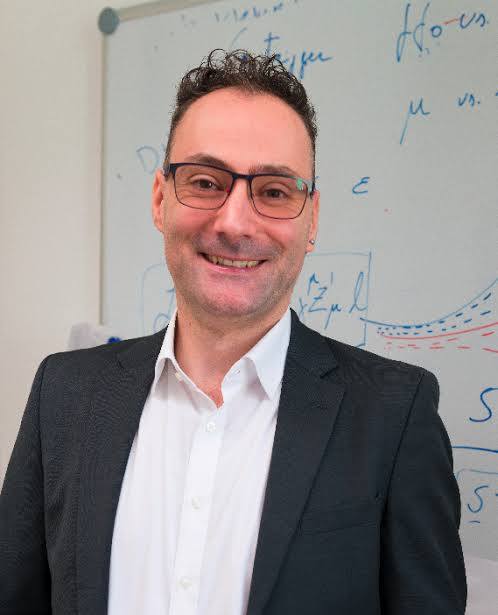
Gianluca Inguglia
Vienna · ÖAW · 2020

01 — About

Who I am

I am a European researcher and group leader at the Marietta Blau Institute for particle physics (MBI) of the Austrian Academy of Sciences (ÖAW) in Vienna — previously also known as the Institute of High Energy Physics (HEPHY).

My research focuses on two main areas with a common pillar. First, I study the smallest known objects in the universe — quarks and leptons — searching for anomalies in their behaviour that could point to new forces of nature, unknown particles, or other unexplained phenomena, using the Belle II experiment. Second, I coordinate gravitational wave research at MBI, leading the local Einstein Telescope Research Unit and the Virgo Group, developing analyses of intermediate-mass black holes and other compact objects using their gravitational wave signatures.

The common pillar across both areas is the development and use of advanced analysis methodologies based on artificial intelligence, machine and deep learning.

I am originally from Palermo, Sicily, and studied Astronomy at the University of Bologna (BSc, 2008), Nuclear Physics in Groningen (MSc, 2011), and Particle Physics in London (PhD, 2014). Afterwards, I worked as a postdoctoral fellow at DESY on the Belle II experiment (Hamburg, 2014) before joining the Austrian Academy of Sciences in Vienna, where I have led my research since 2017.

Download CV
2017 –
Vienna, Austria
Group Leader, MBI / ÖAW
2014
Hamburg, Germany
Postdoctoral Fellow, DESY — Belle II
2014
London, UK
PhD, Particle Physics — Queen Mary University of London
2011
Groningen, Netherlands
MSc, Nuclear Physics — University of Groningen
2008
Bologna, Italy
BSc, Astronomy — University of Bologna
origin
Palermo, Sicily
Born in Sicily, Italy
01

Flavour Physics

Rare B-meson decays, tau lepton properties, lepton flavor universality, and dark sector searches at Belle II — a high-precision window onto new forces and particles beyond the Standard Model.

B→K(*)νν̄EW PenguinsTau LFUDark SectorZ′ Searches
02

Gravitational Waves

IMBH and compact object detection, Einstein Telescope science, LVK burst searches, and black hole population studies. Coordinator of the IMBH task force in the ET Observational Science Board.

IMBH DetectionEinstein TelescopeLVK BurstsET Task Force
03

Artificial Intelligence

Developing bespoke ML tools: Punzi-nets, convolutional autoencoders, weakly supervised anomaly detectors, and hardware neural-network triggers — AI as a precision instrument for frontier physics.

Punzi-netsConv. AEWeakly SupervisedHW NN Trigger
Funded by Austrian Academy of Sciences · ERC StG InterLeptons, grant nr. 947006 · Austrian Science Fund FWF

02 — Flavour Physics

Quarks & leptons at Belle II

Electroweak
Penguins &
B→K(*)νν̄

Flavour-changing neutral currents

Flavour-changing neutral currents (FCNCs) are rare processes forbidden at tree level in the Standard Model, proceeding instead via quantum loops — electroweak penguin diagrams. These suppressed processes are exquisitely sensitive to new physics: new heavy particles such as new vector bosons might be exchanged in the loops, modifying decay rates or angular distributions of final states.

The weak decay B⁺→K⁺νν̄ is a prime example: with large missing energy from the neutrino pair, it is extremely challenging to detect and accessible only at B factories. A significant tension has emerged between the observed branching fraction and the Standard Model prediction. I use inclusive reconstruction techniques to investigate this process using Belle data, and I am preparing new measurements at Belle II. Confirming this tension would point towards new physics, possibly connected to a dark sector.

Tau Lepton &
Lepton Flavor
Universality

World's most precise test of LFU in τ decays

The tau lepton is the heaviest of the six leptons and the only one that can decay to quarks, making it a powerful probe of the Standard Model. The SM predicts that the weak bosons couple equally to all lepton generations — lepton flavor universality (LFU). Any deviation is an unambiguous sign of new physics.

I coordinated the world's most precise test of LFU in leptonic tau decays at Belle II, using a neural network and the 1×1 tau decay topology, comparing the decay rates τ→μνν̄ and τ→eνν̄. At the current precision, the result strikingly confirms the SM prediction — but is not yet conclusive. New measurements using different topologies, which I am also coordinating, will sharpen the picture further.

Dark Sector
Searches

Searching for light dark matter at Belle II

The failure of WIMP dark matter candidates — including supersymmetric neutralinos — has prompted a rethink of dark matter paradigms. The dark sector posits a new set of particles and interactions in the sub-GeV mass range, directly accessible at Belle II's high luminosity.

I have coordinated several dark sector searches at Belle II: invisible decays of a light Z′ boson, muonic Z′ decays, and associated production of an invisible Dark Higgs boson with a dark photon decaying to muons. No new particles were found, but we have excluded wide ranges of parameter space — masses and couplings — that these hypothetical states could occupy.

03 — Gravitational Waves

Black holes & spacetime

According to Einstein's general theory of relativity, gravity is the result of spacetime curvature caused by mass and energy. When massive objects accelerate — as in two black holes orbiting in a binary system — they create ripples in spacetime that propagate at the speed of light: gravitational waves. When these pass through a laser interferometer, they stretch and contract its arms, producing a detectable interference signal from which the source properties can be inferred.

Intermediate-mass black holes and other compact objects

Intermediate-mass black holes (IMBHs, 100–100,000 M☉) and other compact objects remain among the least understood in the universe. My group develops AI-based detection pipelines — including weakly supervised convolutional autoencoders — to identify their merger signals in gravitational wave data. This work, published in Physics Letters B, demonstrates that anomaly detection techniques can recover signals in Einstein Telescope noise without explicit signal models.

The Einstein Telescope

The Einstein Telescope is a proposed underground third-generation GW observatory to be built in Europe (candidate sites: Sardinia and the Euregio Meuse-Rhine), operating after 2035. It will detect one GW event every ~30 seconds — making current parameter estimation methods computationally impossible without AI. ET will enable population studies of black holes across cosmic ages, reaching redshifts up to z ~ 100. I coordinate the IMBH task force within the ET Observational Science Board.

LVK / Virgo

I also participate in the current generation of GW science through the LIGO-Virgo-KAGRA collaboration, contributing to burst searches for unmodelled GW transients and the offline analysis of data with PyCBC. My team is also involved in the construction of the Virgo upgrade planned before O5.

My roles in GW science
IMBH Task Force Coordinator — ET OSB
Lead, ET Research Unit at MBI / ÖAW
Lead, Virgo Group at MBI / ÖAW
LIGO-Virgo-KAGRA Collaboration member
Burst search working group
PyCBC matched-filter analyses
Interactive BH waveform explorer

Explore how BBH merger waveforms change with component masses, distance, inclination, and ringdown timescale. Apply detector bandwidth cuts and listen to the sonified chirp.

Open on GitHub →
LIGO · Virgo · KAGRA · LIGO-India
4 km
LIGO arm length · Hanford & Livingston, USA
3 km
Virgo arm length · Cascina, Italy
3 km
KAGRA arm length · Kamioka, Japan
~4 km
LIGO-India · Aundha, India (under construction)
~400
Cumulative GW detections through O4
Einstein Telescope
10 km
Arm length in the triangular configuration
15 km
Arm length in the L-shaped configuration
z ~ 100
Maximum redshift reach — population studies across cosmic ages
1 / 30 s
Expected GW detection rate — one event every ~30 seconds
post-2035
Planned operational start for this third-generation detector

04 — Artificial Intelligence

AI at the frontier of physics

Artificial intelligence is not a tool I apply after the physics is done — it is embedded in how I formulate the problems themselves. From the design of optimal search strategies at Belle II to the detection of gravitational wave signals without explicit signal models, AI and deep learning are the methodological core of my research programme.

Punzi-nets &
Optimal Search
Sensitivity

Punzi-loss: end-to-end optimisation for discovery

The Punzi figure of merit is the standard sensitivity metric in searches for new particles at B factories, but it is non-differentiable and thus cannot be used directly as a loss function in neural network training. I developed Punzi-loss — a smooth approximation that allows end-to-end optimisation of neural networks directly for discovery sensitivity, rather than for classification accuracy.

This approach, published in EPJC, was adopted across multiple Belle II analyses and represents a principled departure from surrogate metrics. Rather than training a network to classify signal from background and then optimising a cut, Punzi-nets optimise directly for what matters: the ability to claim a discovery.

Anomaly Detection
for Gravitational
Waves

Weakly supervised convolutional autoencoder for IMBH detection

Searching for intermediate-mass black hole mergers in gravitational wave data is challenging because the signals are rare, poorly modelled, and buried in non-Gaussian detector noise. I developed a weakly supervised convolutional autoencoder (CAE) that learns a model of detector noise and flags deviations consistent with compact binary coalescences — without being trained on signal waveforms.

This approach, published in Physics Letters B, demonstrated efficient IMBH recovery in simulated Einstein Telescope data and establishes a blueprint for model-agnostic GW searches at next-generation detectors. The method is particularly powerful for signals where matched filtering is impractical due to incomplete waveform models or the sheer volume of expected events.

Hardware Neural
Network Trigger

Real-time deep learning at 30 MHz

At Belle II, the first hardware trigger level must make real-time decisions at the 30 MHz bunch-crossing rate of the SuperKEKB collider, with a latency of microseconds. I contributed to the development and commissioning of a neural network implemented directly in FPGA firmware — the first hardware NN trigger at a B factory.

This work, published in NIMA, demonstrates that deep learning can operate at the extreme speed and latency constraints of real particle physics experiments. It opens the door to AI-driven data selection at the earliest stage of the acquisition chain, reducing data volume while preserving rare signal events that classical trigger logic would discard.

05 — Funding

Grants & support

European Research Council
ERC Starting Grant — InterLeptons
Grant nr. 947006. World-leading measurements in lepton flavor universality and rare B-meson decays at Belle II, including the world's most precise test of LFU in leptonic tau decays and multiple dark sector searches.
cordis.europa.eu →
Austrian Science Fund — FWF
Improved search for B⁺→K⁺νν̄ at Belle II
Grant PAT1823724 · ongoing (2025–2029) · €360,940. Investigating the tension between the observed B⁺→K⁺νν̄ branching fraction and Standard Model predictions, using deep neural networks and inclusive tagging on Belle II data.
fwf.ac.at →
Austrian Science Fund — FWF
Searches for Dark Matter and Dark Forces at Belle II
Grant P31361 · completed (2018–2023) · €278,334. Pioneering searches for dark sector particles at Belle II, including the first paper published by Belle II (PRL, 2020) and multiple exclusions of dark Z′ and dark Higgs parameter space.
fwf.ac.at →
Austrian Academy of Sciences
ÖAW Core Funding
Institutional support for the MBI research unit, enabling sustained research in both flavour physics and gravitational wave science.

06 — Publications

Selected papers

I have co-authored several hundred scientific papers. A curated selection is listed below; the complete list is on INSPIRE-HEP.

2026
The Science of the Einstein Telescope
ET Collaboration · arXiv:2503.12263
2025
Towards an anomaly detection pipeline for gravitational waves at the Einstein Telescope
Physics Letters B · G. Inguglia et al. · arXiv:2511.13154
2025
Adaptive scattered light noise subtraction in gravitational wave detectors
Classical and Quantum Gravity
2024
Test of light-lepton universality in τ decays with the Belle II experiment
JHEP · Belle II Collaboration · arXiv:2405.14625
2024
Light new physics in B→Kνν̄?
Physical Review D · arXiv:2311.14629
2024
The neural network first-level hardware track trigger of the Belle II experiment
NIMA · arXiv:2402.14962
2024
Search for a μ⁺μ⁻ resonance in four-muon final states at Belle II
Physical Review D · Belle II Collaboration · arXiv:2403.02841
2023
Search for an invisible Z′ in a final state with two muons and missing energy at Belle II
Physical Review Letters · Belle II Collaboration · arXiv:2212.03066
2023
Search for a dark photon and an invisible dark Higgs boson in μ⁺μ⁻ and missing energy final states with the Belle II experiment
Physical Review Letters · Belle II Collaboration · arXiv:2207.00509
2022
Snowmass White Paper: Belle II physics reach and plans for the next decade and beyond
Belle II Collaboration · arXiv:2207.06307
2022
Testing lepton flavor universality with pion, kaon, tau, and beta decays
Annual Review of Nuclear and Particle Science · arXiv:2111.05338
2022
Towards excluding a light Z′ explanation of b→sℓ⁺ℓ⁻
Physical Review D (Letter) · arXiv:2202.12900
2022
Punzi-loss: a non-differentiable metric approximation for sensitivity optimisation in the search for new particles
European Physical Journal C · arXiv:2110.00810
2020
Search for an invisibly decaying Z′ boson at Belle II in e⁺e⁻→μ⁺μ⁻(e±μ∓) plus missing energy final states
Physical Review Letters · Belle II Collaboration · arXiv:1912.11276
2011
Time-dependent CP asymmetries in D and B decays
Physical Review D · arXiv:1106.5075
07 — Outreach

Science for everyone

Outreach is a core part of a researcher's responsibility, not an afterthought. Working with public funding means communicating the purpose, methods, and implications of research to the general public is both a duty and a privilege.

My team and I take outreach seriously and regularly share our results with the public. If you want to hear more at one of your events, do not hesitate to contact me.

I am a member of the Società Italiana di Fisica.

Topics I speak about
Gravitational waves and the Einstein Telescope
Black holes across the mass spectrum
The Standard Model and its open questions
Dark matter: what we know and don't know
Artificial intelligence in fundamental physics
Matter, antimatter, and the origin of the universe

Contact
InstitutionMarietta Blau Institute for Particle Physics
Austrian Academy of Sciences (ÖAW)
LocationVienna, Austria
CollaborationsBelle II · Virgo · Einstein Telescope · LVK
MembershipsSocietà Italiana di Fisica · Young Academy of Europe · ÖAW